

Why Agrifood Innovation Fears Uncertainty More Than Regulation
A global comparison of the cost, time and predictability involved in bringing agrifood innovation to market.
Agrifood innovation is often described as being caught between two opposing objectives: protecting people and the environment, and bringing new technologies to market quickly enough to remain competitive.
That framing is incomplete.
Innovators generally accept that products affecting food, health and the environment must be assessed thoroughly. What is harder to accept—and much harder to finance—is uncertainty about how much evidence will ultimately be required, how long the process will last, and whether a scientifically completed assessment will lead to a stable regulatory decision.
The decisive distinction is therefore not between regulation and deregulation. It is between risk-based regulation that can be planned around and regulatory uncertainty that cannot be priced.
The comparison below considers six broad agrifood technologies across nine regulatory systems. It is not a formal index. It is an indicative synthesis of published regulatory, academic and industry evidence, designed to expose the variables that most influence investment decisions: entry cost, time to market, proportionality, institutional coordination and the stability of the final decision.
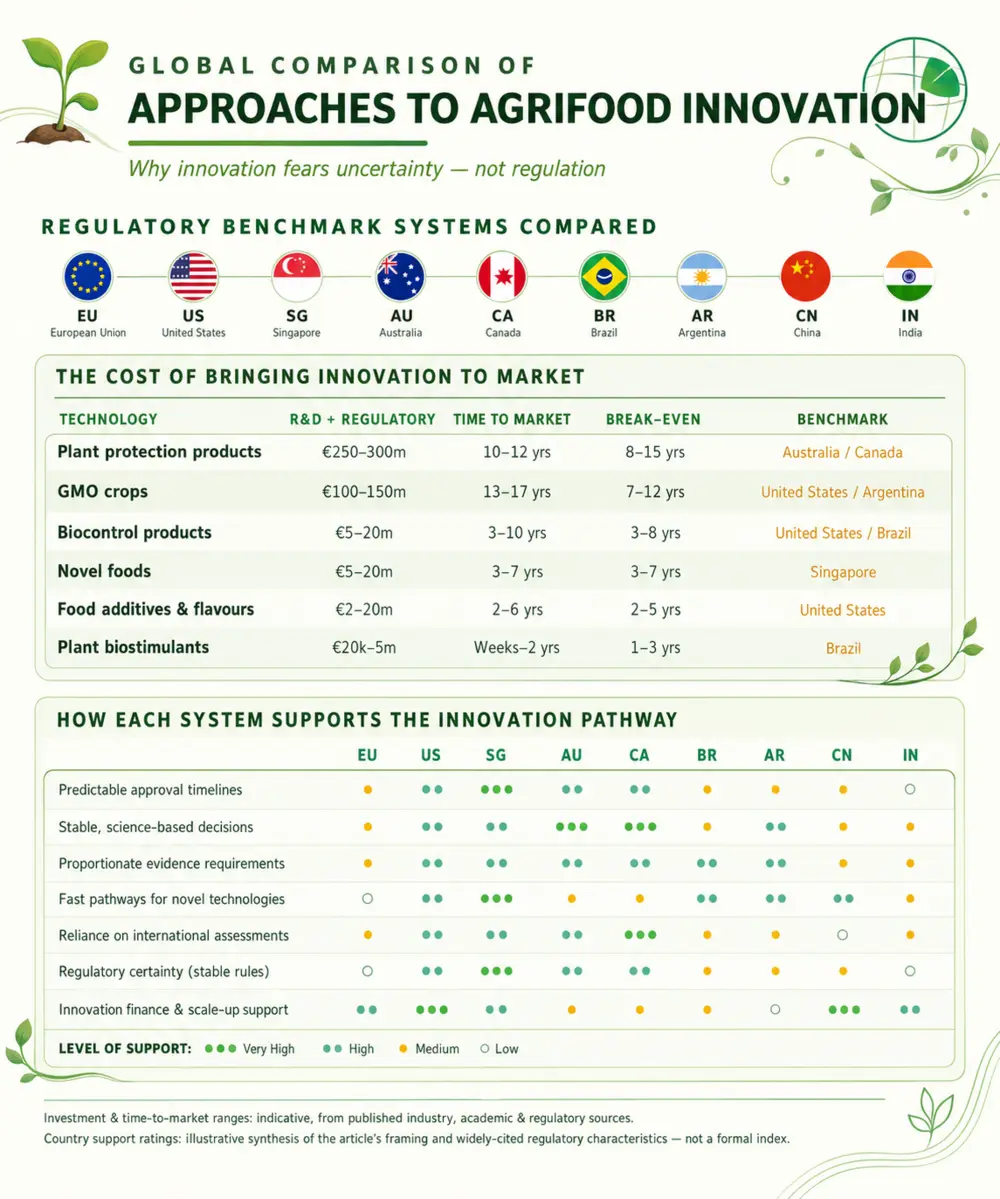
The first burden is visible: the cost of entry
Bringing an agrifood technology to market is expensive everywhere.
A new crop-protection active substance may require well above €250 million when discovery, unsuccessful candidates, toxicology, environmental studies, field trials, formulation development and regulatory work are considered together. A genetically modified crop can require investment exceeding $100 million. Even apparently lighter categories—such as novel foods, biocontrol products, additives or microbial inputs—can require several million euros before meaningful commercial revenue begins.
These figures should be handled carefully. “Regulatory cost” is not a single accounting category. Some estimates include only dossier preparation and authority fees. Others include the studies needed to satisfy regulatory requirements, failed development pathways, financing costs and the revenue lost while a product waits for approval.
Nevertheless, the scale is real.
A 2026 OECD comparison of EU and US biotechnology regulation cited an estimated €11 million to €16.7 million for an EU GM food-and-feed approval. The same study reported that bringing a new GM crop to market globally in 2017–2022 cost, on average, more than $115 million, with the regulatory phase accounting for 37.6% of total development expenditure—approximately $43 million—and more than half of the development time.
The burden is not unique to Europe. The United States also has overlapping agency responsibilities, demanding evidence requirements and areas of regulatory uncertainty. Australia and Canada maintain rigorous pre-market controls in several agrifood categories. Singapore’s novel-food pathway is exacting, particularly for products such as cultivated meat.
The difference is often not whether evidence is required, but whether the company can establish early enough:
- which authority is responsible;
- which studies will be accepted;
- whether international evidence can be relied upon;
- how requests for additional information will be bounded;
- and when a decision should reasonably be expected.
The cost of a known study programme can be budgeted. An evidence requirement that changes after the programme has begun cannot.
What the economy-wide figures really tell us
More than 60% of EU companies describe regulation as an obstacle to investment, while 55% of SMEs identify regulatory obstacles and administrative burdens as their greatest challenge. These are perception-based survey findings, not measurements of the total cost of EU law. But they are too large to dismiss as marginal dissatisfaction.
A newer OECD measure helps quantify part of the burden. Rather than attempting to price every individual rule, it estimates the share of labour devoted to regulation-related tasks. For selected European countries, the employment-based measure rose from 3.7% in 2011 to 3.9% in 2023, a higher level than the comparable US indicator. In the United States, the wage share devoted to compliance tasks increased from 4.0% in 2012 to 4.2% in 2024; Australia’s was approximately 4.5%.
Those numbers should not be collapsed into a simplistic league table: wage-based and employment-based indicators are not identical, and regulation produces social benefits as well as costs. They nevertheless show three important things.
First, compliance absorbs a material share of productive capacity in all advanced economies. Europe is not alone in regulating.
Second, the European burden appears to be rising and, on the OECD’s comparable employment measure, is higher than in the United States.
Third, aggregate percentages conceal the distributional problem. The same obligation can be modest for a multinational with an established regulatory department and prohibitive for a start-up employing twelve scientists.
Regulation therefore operates partly as a fixed cost. It does not decline because the applicant has fewer employees, less revenue or a smaller addressable market. A €10 million evidence package may be a manageable portfolio expense for a global company. For an agrifood start-up, it may represent the entire seed round and several years of runway.
This is why regulatory burden can increase concentration even when every applicant is formally treated equally. Equal requirements do not necessarily create equal access.
Time is also a cost—but delay is not the whole problem
The most revealing international comparisons concern time to decision.
According to the OECD’s 2026 EU–US biotechnology study, approval of GM crop imports has been estimated at up to six years in the European Union, compared with approximately 1.8 years in the United States, one year in Australia and five months in Canada. EU novel-food authorisations have been estimated at approximately 2.6 years.
These figures vary by product and dossier, and unusually complex applications can distort averages. Yet the commercial effect of delay is straightforward.
Every additional year means:
- another year of specialist staff and external-adviser costs;
- another year before production assets generate revenue;
- another financing round under regulatory uncertainty;
- another opportunity for a competing jurisdiction to establish manufacturing capacity;
- and one less year of effective commercial return before patents or other protections weaken.
The financial consequence is not linear. A delay near the beginning of development may be manageable. A delay after the company has built a facility, recruited a team or prepared a launch can threaten the entire business.
But even speed is not the complete issue. A slow system with clear milestones may still be investable. A nominally faster process in which the evidence standard, political context or institutional interpretation may change is much more difficult to finance.
Capital markets price duration. They discount uncertainty more severely.
The EU–third-country gap lies in regulatory architecture
The EU’s disadvantage is not explained simply by a preference for higher safety standards.
In several fields, the underlying data requested in the EU are broadly comparable to those required elsewhere. The difference lies in how the evidence is generated, interpreted and carried through the institutional process.
The OECD identifies several recurring contrasts between the EU and the United States:
- EU requirements are generally more prescriptive, with less scope for case-specific derogations.
- Pre-submission exchanges between applicants and regulators are more limited, increasing the risk that studies later prove insufficient or incorrectly designed.
- Responsibilities are divided among EU institutions, agencies and Member States.
- Scientific assessment and political risk management are institutionally separate.
- In the United States, applicants generally have more opportunity to clarify testing requirements before submission, although the greater reliance on producer responsibility and limited review in some pathways has also attracted criticism.
Other jurisdictions have made different choices.
Canada and Australia make substantial use of defined, science-based pathways and international regulatory cooperation. Singapore has used early engagement and clearer novel-food guidance to reduce procedural uncertainty, while retaining intensive safety assessment. Argentina and Brazil have developed more proportionate routes for certain agricultural biotechnologies and biological inputs. China can combine considerable approval uncertainty with powerful public financing and scale-up support. No jurisdiction is uniformly “innovation friendly”; each combines strengths and weaknesses differently.
This is why the correct comparison is not Europe versus a single alternative model. It is Europe versus a portfolio of regulatory design choices already being tested elsewhere.
The problem continues after approval
Entry requirements are only one side of regulatory certainty. The other is the durability of the decision.
EU GMO authorisations are generally granted for ten years and must then be renewed. China uses a shorter five-year validity period for certain environmentally released GMOs. By contrast, authorisations in the United States, Canada and Brazil are generally indefinite unless new evidence creates a reason for regulatory intervention.
Neither approach is automatically correct. Periodic review can capture new scientific knowledge. The question is whether renewal is targeted at genuinely new risk information or becomes a repeated reconstruction of an assessment already completed.
A functioning precautionary system must remain capable of responding to new evidence. But precaution should not mean that every conclusion is permanently provisional.
If a company cannot rely on an approval after satisfying the applicable scientific standard, the cost of that instability is incorporated into the investment decision from the beginning. The company may launch elsewhere first, reduce the European programme, license the technology to a larger operator or abandon the application entirely.
The innovation lost in this way is largely invisible: it appears not as a rejected dossier, but as a dossier never submitted.
Regulatory burden and access to capital reinforce each other
Europe’s regulatory environment cannot be separated from its financing environment.
The OECD finds that US biotechnology companies benefit from venture-capital investment on an entirely different scale: aggregate venture funding is described as orders of magnitude higher in the United States. The United States also files roughly twice as many biotechnology patent applications as the EU, while US biotechnology start-ups have filed almost four times as many patents as their EU counterparts in the OECD dataset.
Regulation alone does not explain these gaps. Market size, pension and capital-market structures, university technology transfer, public procurement, entrepreneurial culture and exit opportunities all matter.
But regulatory uncertainty interacts with each of them.
A deep capital market can carry a company through an unexpectedly long approval process. A shallow one cannot. Conversely, a predictable regulatory pathway reduces the amount of capital a company must raise before it can demonstrate commercial viability.
Europe therefore faces a compounding disadvantage: less risk capital is available precisely where more capital may be needed to survive the regulatory pathway.
The answer is not simply to subsidise companies for enduring avoidable delay. It is to reduce the uncertainty that makes the additional financing necessary.
Proportionality does not mean lower protection
A proportional system does not ask less serious questions. It asks the right questions at the right level.
Evidence requirements should respond to the novelty, exposure and plausible risk profile of the product, rather than solely to the legal category into which the technology happens to fall. A familiar organism producing a well-characterised substance should not automatically face the same evidentiary architecture as a novel organism intended for environmental release.
Similarly, previous assessments should matter. Data accepted in a trusted jurisdiction should not be repeated without a specific scientific reason. Platform technologies should be able to build on validated knowledge rather than restart from zero for every variation.
Proportionality can therefore include:
- binding pre-submission advice;
- clearer classification decisions at an early stage;
- tiered evidence requirements;
- greater reliance on validated international assessments;
- defined limits and reasons for stopping the regulatory clock;
- fast or adapted pathways for low-risk variations;
- and reopening decisions only when genuinely new evidence warrants it.
None of these measures requires lowering the level of health or environmental protection. They require regulators to distinguish between the information necessary to reach a decision and procedure that persists because it has accumulated over time.
Europe is beginning to test a different approach
The direction of EU policy is changing, although implementation remains incomplete.
The new framework for plants produced through certain new genomic techniques was adopted in 2026. It creates a differentiated pathway for NGT plants considered comparable to conventionally bred plants, while retaining the existing GMO framework for more complex modifications. Most of its provisions are expected to apply only after a transition period, from around mid-2028. Its practical value will therefore depend heavily on the implementing rules and the consistency of national verification.
The Commission’s 2026 biotechnology proposals also move toward regulatory sandboxes, better coordination and more adaptable pathways. These proposals are important signals, but they are not yet operational law and should not be treated as achieved simplification.
The Commission has separately committed to reducing administrative burdens by at least 25% for companies generally and 35% for SMEs, with a stated objective of generating €37.5 billion in savings by 2030. The scale of the target confirms that regulatory accumulation is now recognised as a competitiveness issue.
The test will be whether simplification changes the experience of an actual applicant—not merely the number of reporting fields counted in an impact assessment.
The real competitiveness test
Europe does not need to choose between precaution and innovation.
It needs to determine whether precaution can be made compatible with proportionality, procedural discipline and decisions that remain stable unless new evidence justifies reopening them.
The strongest regulatory systems do three things at once:
- They ask enough of applicants to protect people and the environment.
- They make those expectations sufficiently clear for companies and investors to plan.
- They bring the process to a conclusion that has institutional durability.
Europe is strongest on the first. Its competitiveness problem lies increasingly in the second and third.
The objective should not be the cheapest regulatory system, nor simply the fastest. It should be a system in which the cost and time demanded are proportionate to risk—and in which an applicant can know, before committing capital, what reaching the end of the process will mean.
“Innovation can price regulation. What it cannot price is a process without a stable endpoint.”
Principal sources
Discuss the implications for your file.
First conversations are exploratory and without obligation.
Contact Nexum